In English, wish is a powerful word for expressing your dreams, hopes and desires. Here are some examples: We wish you the best. Her mother wishes they would get married. I wish I had brought my camera. I wish to speak to the president.
You will often hear wish in music, movie dialog, poetry and inspirational speeches. Let’s take a look at some of the tricky grammar issues with wish.
A wish is a desire for a different reality. In general, wishes
express desires that are unlikely to happen. If you say, “I wish I could
fly,” it means you probably will not grow wings and learn to fly. A Unique Verb
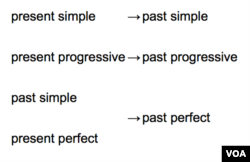
Wish follows a unique -- and rather confusing -- set of grammar rules. Wish uses the same verb back shifting rule as reported speech.
Verb back shifting
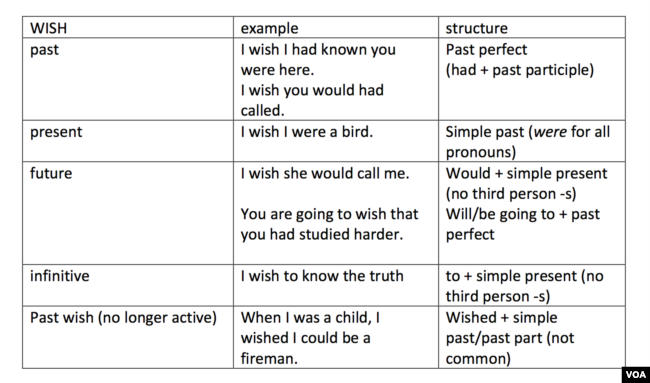
A wish about the present uses a simple past main verb. He wishes he understood the lesson.
In this example, understood is a simple past verb. Wish is often followed by that. That introduces a noun clause. It is optional. For example:
I wish that I looked like a movie star.
I wish I looked like a movie star.
Both of these sentences have the same meaning.
In hypothetical situations, such as wishes and conditionals, use were for all pronouns. I wish you were here. I wish she were here. I wish I were there.
In everyday conversation, you might hear was after wish. For example, “I wish I was the president.” Was is acceptable in informal situations, but you should use were in formal situations. This confusing rule comes to English through Latin. Future wishes
Wish followed by would usually implies a request. For example:
I wish you would finish college before you get married.
Wish can be used after be going to or will to predict a future regret. Maybe you have heard your parents say something like this:
Someday, you are going to wish you had taken my advice.
When you are older, you will wish that you had studied engineering.
Past wishes
Let’s take a closer look at past wishes. Generally, a past wish is a
wish that did not come true. To refer to a past wish, use a past perfect verb after the object. To form the past perfect, use had followed by a past participle verb. She wishes she had written down the phone number. I wish I had known that you were in town last week.
Listen to country singer Gene Autry make a past wish in an old song
called “I Wish I Had Never Met Sunshine.” In this song, Sunshine is the
name of a lost lover.
I wish I had never met Sunshine,
and Sunshine had never met me
For 21 years I'll regret it
'Cause I'm in the jailhouse, you see
Most of the time, a wish about the past suggests regret. The speaker
would have acted differently if he or she could turn back time. A past
wish has a similar grammatical function to a past unreal conditional.
Listen to this song by Taylor Swift. You will hear three different uses of wish. She starts with a future wish, then shifts to the past, then to the present.
I wish you would come back (future)
(I) wish I (had) never hung up the phone like I did (past)
I wish you knew that I'll never forget you as long as I live. (present)
I wish you were right here, right now it’s all good (present)
Wish + infinitive Wish followed by an infinitive makes a strong demand. For example: I wish to speak to the manager. I wish to learn the truth about what happened. Wish can be followed by an infinitive, but never by a gerund. For example, it would sound strange to say, “I wish going skiing.” The correct form is, “I wish to go skiing.” Hope vs. Wish
What’s the difference between hope and wish? In some contexts they can be interchangeable. Hope usually expresses desire that is possible. Wish, on the other hand, refers to an outcome that is not likely to happen.
Pay attention to the different contexts of hope and wish in these examples. I hope you pass the test. (possible) I wish I could fly. (impossible) I hope I get to work on time. (possible) I wish I were a millionaire. (not likely)
If wish is “reaching for the stars,” then hope is “reaching for the sky.”
And that’s Everyday Grammar. We hope you will write to us in the Comments and on our Facebook page.
I’m John Russell.
And I’m Ashley Thompson.
[Pink Floyd]
How I wish, how I wish you were here
We’re just two lost souls…
Adam Brock wrote this story for VOA Learning English. Dr. Jill Robbins and Kathleen Struck were the editors.
"Wish" in different tensesText Source:
Brock, Adam. “Wish You Knew Better Grammar?” Edited by Robbins Jill and Struck Kathleen , VOA, VOA - Voice of America English News, 9 June 2016, learningenglish.voanews.com/a/everyday-grammar-making-wishes/3218288.html.
Introduction These four questions are made with modal verbs : Would you... ? Could you... ? Will you... ? Can you... ? Modal verbs are helping/auxiliary verbs that express ideas like ability , permission , and asking for assistance . Many modal verbs have more than one meaning. They are always followed by the simple form of a verb. For example: Could you help me for a minute, please? This shows that the speaker is asking for help politely. To ask questions in a very polite way, use: Would you/ Could you (please) + simple verb + ...? For example: Would you please email that document to me? I need it ASAP*. Could you explain that again, please? I didn’t understand. *ASAP = a s s oon a s p ossible To ask questions in a polite but more casual way , say: Will you/ Can you (please) + simple verb + ...? For example: Will you please answer the phone? I’m worki...
This week, we are going to talk about the future tenses. There are several ways to talk about future events in English. Compared to the past and present, future tenses are usually more flexible. Will Let’s start with will . To form the simple future, use will and then the simple form of the verb. For example, “I will go to the store.” In everyday conversation, will often gets shortened , which can be difficult for English learners to hear. For example, “I’ll leave tomorrow” or “He’ll go to the store.” You can use will to express a desire to do something. “I’ll help you move tomorrow” or “I’ll answer the phone.” Be going to The second form of the simple future is be going to . For example, “I am going to start a new job tomorrow.” Use be going to when you already have a plan to do something. When you say “I’m going to start a new job tomorrow,” you made the plan in the past. If you do not have a plan, use...
When you woke up this morning, you probably did at least five things before you left your home for school or work. Maybe you ate breakfast, took a shower, brushed your teeth, put on your clothes, and looked at the news or internet. For each thing you did, you did something else before, during or after those other things. For example: Before I ate breakfast , I did 20 minutes of yoga . “Before I ate breakfast” is an adverb clause. In an earlier program, we told you about adverb clauses . Today, we will show you how to shorten these clauses. Shortened adverb clauses often sound more natural and concise in English. We call the shortened clauses “ modifying adverbial phrases .” But, that name is needlessly complex for a grammar structure that is often easy for many English learners. Listen to the example again: Before I ate breakfast , I did 20 minutes of yoga. Here is how we shorten it: Before eating breakfast , I did 20 minutes of yog...
Comments
Post a Comment